
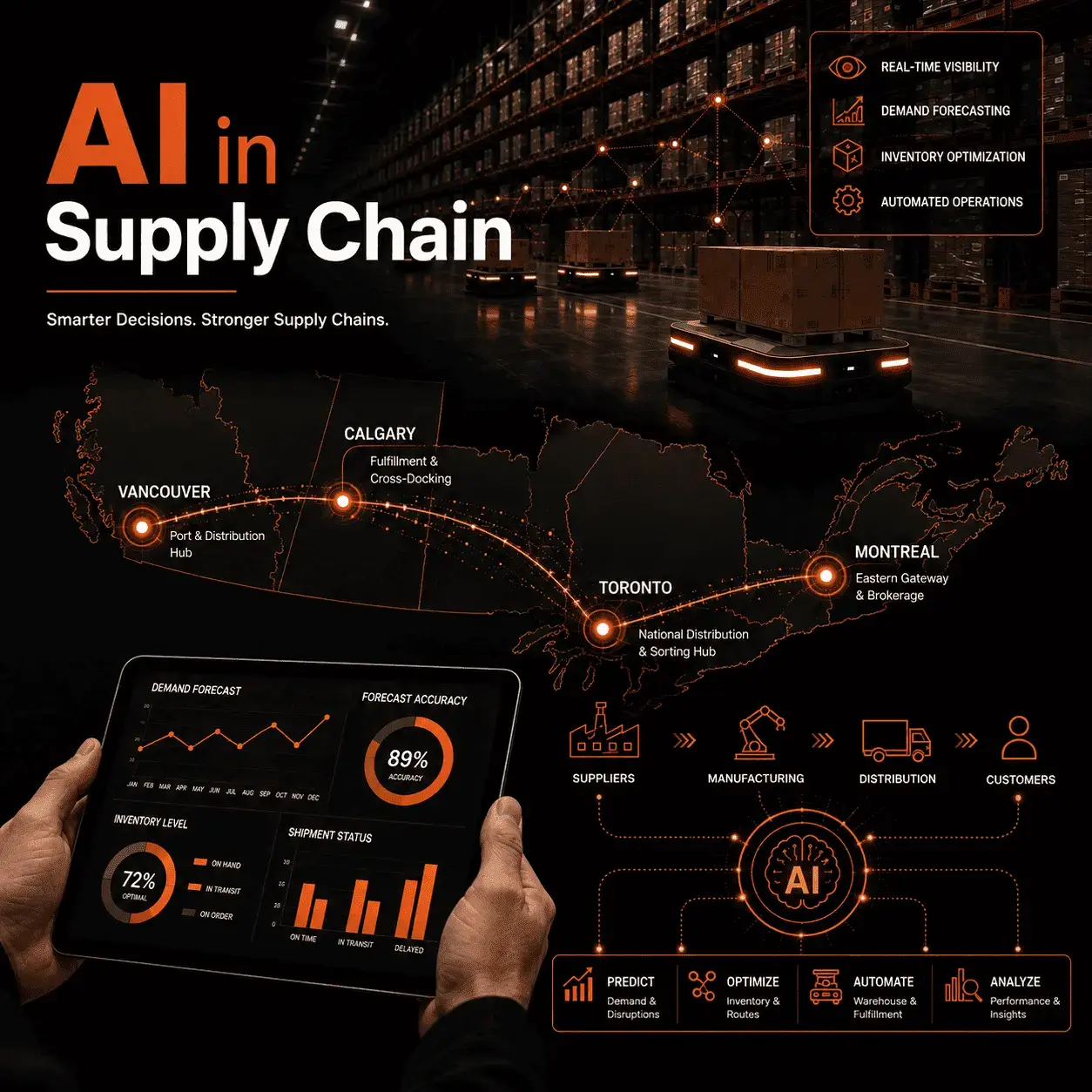
AI Supply Chain is a practical reference for people who plan, buy, store and move goods. It explains how artificial intelligence and analytics are used in supply chain management, with free calculators, step-by-step guides and plain-language comparisons. Everything is written for operations and supply chain teams, with a Canadian angle where it matters.
What is AI in supply chain management?
AI in supply chain management means using machine learning and related methods to improve decisions about demand, inventory, transportation, warehousing and suppliers. Models find patterns in past and live data, then recommend an order quantity, a delivery route or a risk alert for a person to review.
The value comes from tying AI to a specific decision with a measurable cost, not from adding it everywhere. The sections below show where it helps, how to begin and where to read more.
Where AI helps most
- Planning: forecasting demand and balancing supply. See demand planning and optimization.
- Inventory and warehouses: reorder rules, safety stock, picking and layout. See inventory and warehousing.
- Logistics: routing, fleets, freight and last-mile delivery. See logistics and transportation and AI in logistics.
- Risk: early warning on disruptions and supplier problems. See risk and resilience.
- Procurement: sourcing, contracts and vendor performance. See procurement and suppliers.
- Visibility: tracking, IoT and digital twins. See visibility and digital technology.
How to start
- Pick one decision with a clear cost, such as forecast error or late deliveries.
- Check the data you have and fix timestamps and master records first.
- Measure the current result so you have a baseline.
- Run a small pilot and compare it with the baseline.
- Keep a person in control with clear rules for override and escalation, then scale what works.
The guide to AI in supply chain management covers strategy, vendors and common mistakes in more depth.
Free supply chain calculators
Use our calculators to put numbers on a decision. Each one shows the formula, a worked example and its limits.
- AI supply chain ROI calculator
- Safety stock calculator
- Reorder point calculator
- Economic order quantity (EOQ) calculator
- Landed cost and chargeable weight calculator
- Canada import duty and GST calculator
- Forecast accuracy calculator
- Supply chain disruption cost estimator
Browse by topic
- AI in Logistics: Routing, load matching, dock scheduling and delay prediction: see how artificial intelligence works in logistics, with guides on tools and costs.
- AI in Supply Chain Management: Plan, pilot and scale AI across planning, sourcing and fulfilment.
- Machine Learning in Supply Chain: Forecasting, anomaly detection and optimization models explained for supply chain teams, with practical guides on data needs, tools and payback.
- Demand Planning and Optimization: From forecast accuracy to network optimization: guides on how AI improves demand planning, S&OP, safety stock and supply planning decisions.
- Inventory and Warehousing: Reduce stockouts and overstock, speed up picking and automate the warehouse.
- Logistics and Transportation: Cut delivery times and freight cost with AI routing, fleet management, last-mile tools and cold chain monitoring.
- Supply Chain Risk and Resilience: Predict disruptions, score supplier risk and build resilient networks.
- Procurement and Suppliers: Automate sourcing, spend analysis, contracts and vendor scorecards.
- Visibility and Digital Technology: Track goods in real time and test decisions in simulation.
- Sustainable Supply Chain: Measure Scope 3 emissions, cut waste and plan greener logistics.
- Supply Chain Fundamentals: Core supply chain concepts explained: strategy, process, lean and agile, integration, KPIs and collaboration, with guides for beginners and managers.
- Industry Supply Chains: How supply chains work in pharma, healthcare, automotive, semiconductors, agriculture, retail and other sectors, with the risks and practices of each.
- Supply Chain Technology and Systems: Guides to supply chain software and systems, from ERP, TMS and EDI to AI platforms and vendor reviews, with advice on selection and integration.
- AI Trends, History and Resources: Trends, history, market reports and practical tips on AI in supply chains, plus guides to PDFs, presentations and research papers on the topic.
You can also read the directory of Canadian AI supply chain companies.
AI supply chain in Canada
Canada has strong AI research, government-backed innovation clusters and logistics challenges that suit applied AI, from long distances and winter weather to cross-border trade. Our Canada-focused tools include the import duty and GST calculator and the company directory above.
Common questions
What is AI in supply chain management?
It is the use of machine learning and related methods to support supply chain decisions such as forecasting demand, setting inventory levels, choosing routes and spotting supplier risk. The models learn patterns from historical and live data and give recommendations that planners can accept, adjust or reject.
Where should a company start with supply chain AI?
Start with one decision that has a clear cost and good data, for example demand forecasting for steady products or delivery route planning. Measure the current result, run a pilot against it and expand only if the improvement is real.
Does AI replace supply chain planners?
Not in practice. AI usually handles the repetitive calculations and flags exceptions, while people handle judgement, supplier relationships and unusual events. Good implementations keep a person able to review and override recommendations.
How do I estimate the return on an AI project?
Estimate the savings in the area you target, subtract the full cost including data work and change management, and test the result with low, expected and high assumptions. Our AI supply chain ROI calculator walks through this.
What data does supply chain AI need?
Clean, consistent records of orders, inventory, shipments and lead times, with timestamps that line up across systems. Poor master data is the most common reason projects stall.
Is AI in supply chain different in Canada?
The methods are the same. Canadian operations add long distances, winter conditions, cross-border trade under CUSMA and customs processes, which affect forecasting, transport planning and visibility.