
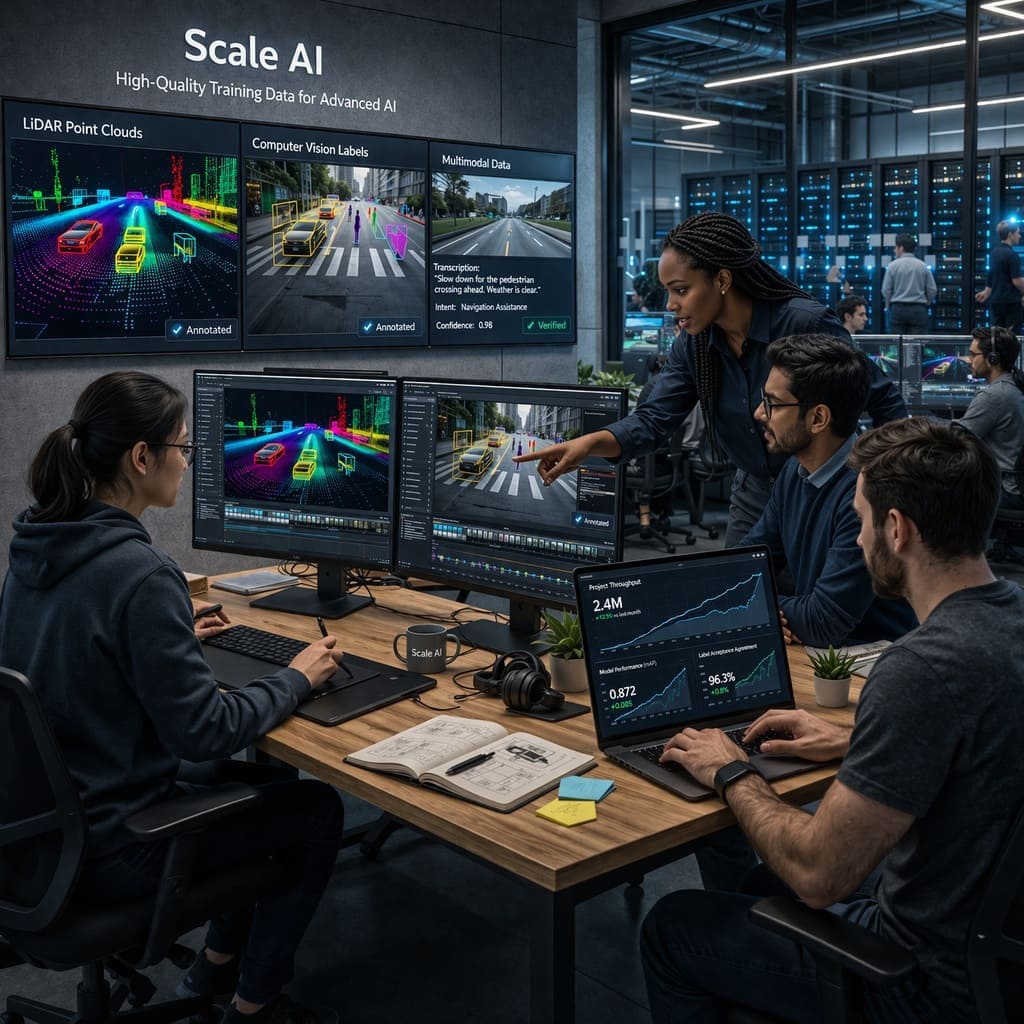
Algorithms are starving. Computing power is cheap. The cloud is almost limitless. But high-quality human-validated data? That’s the rarest and most expensive resource on Earth right now. Without it, all the latest neural networks in the world are just empty engines waiting to run.
Artificial intelligence – the new industrial revolution. Data – the steel. And today, one firm possesses the largest and most efficient steel plant in the world. Meet the sprawling and mysterious world of Scale AI.
You utilize their invisible workforce every single day, often without realizing it. When a self-driving car smoothly stops at a red light, when ChatGPT produces a perfectly structured Python script, or when a military drone successfully identifies a target in a war zone, you’re seeing the direct result of the Scale AI company.
They’re not the ones building the flashy, user-facing chatbots that get all the press. They’re not the ones building the sexy, autonomous vehicles, or the sophisticated medical diagnostic tools. They’re just the ones building the foundation. They’re the ones building the ground truth: the carefully labeled datasets that teach machines how to see, read, and understand our chaotic world.
Before we delve into their mind-boggling multi-billion-dollar valuation, shady defense contracts, and invisible army of human ‘labelers’ working all over the world, there’s one massive point of confusion that everyone from search engines to journalists to investors to the company itself seems to be getting completely wrong.

The Great Divide: Silicon Valley Unicorn vs. Canadian Supercluster
If you Google “Scale AI” right now, you’re going to run into a bizarre corporate collision. Two massive, entirely separate organizations share the exact same name. They operate in completely different worlds, chase different goals, and rely on entirely different funding models. It’s a bit of a branding headache, but understanding the difference is crucial.
-
-
1. Scale AI (scale.com)The Silicon Valley heavyweight. Founded by Alexandr Wang and currently valued at nearly $14 billion, this is the private, for-profit juggernaut powering the foundational models behind OpenAI, Meta, and the US military. Their entire existence revolves around data labeling, RLHF (Reinforcement Learning from Human Feedback), and generative AI infrastructure. In the modern AI gold rush, these are the folks selling the pickaxes.
-
-
2. Scale AI Canada (scaleai.ca)The Canadian Global Innovation Cluster. Based in Montreal, this is a government-backed consortium. They aren’t labeling data for ChatGPT or training self-driving cars. Instead, they manage the Scale AI subvention—distributing massive financial grants to help traditional industries (like shipping, logistics, and manufacturing) integrate artificial intelligence into their supply chains.
We’re going to cover both. First, we’ll unpack the business model, the history, and the future of the Silicon Valley unicorn. Then, we’ll head north to see how the Canadian supercluster is quietly rewiring global logistics. Let’s start in San Francisco.
The Silicon Valley Titan: Inside Scale.com
To truly understand Scale AI what is it, you have to look at its origin story. It reads like a Hollywood script perfectly tailored for Sand Hill Road venture capitalists.
The Boy Genius and the Digital Assembly Line
A 19-year-old dropout from MIT named Alexandr Wang spotted a huge arbitrage opportunity in 2016. Machine learning engineers, who are among the smartest and highest-paid individuals in the world, were spending 80% of their time cleaning, sorting, and labeling data. They were spending only 20% of their precious time building and improving AI models.
The arbitrage opportunity was huge. Alexandr Wang started his Scale AI venture with an idea that was both simple and impossible to resist. Send us your data in any form via our simple API, and we shall return it to you in perfectly labeled form. Alexandr Wang took his idea to Y Combinator, the legendary startup accelerator. They funded him immediately. The timing was absolutely impeccable. The autonomous vehicle revolution was just beginning to take off, and companies like Waymo, Cruise, and Uber needed millions of images of streets, pedestrians, and street signs labeled with precision. Alexandr Wang’s dominance in LIDAR and 3D image annotation made him the youngest self-made billionaire in the world.
But Wang didn’t stop at self-driving cars. He saw the next wave coming and pivoted the entire company toward Generative AI just as the LLM (Large Language Model) revolution crashed over the tech industry. His vision crystallized into a bold, ambitious mission statement: to build “ai systems for the world’s most important decisions.”
— Scale AI Alexandr Wang
Scale AI: Key Milestones
Alexandr Wang drops out of MIT to found Scale AI. The company joins Y Combinator, focusing on providing high-quality data for autonomous vehicles.
Raises $100M Series C led by Founders Fund, reaching a $1 billion valuation and officially becoming a Silicon Valley unicorn.
Raises $325M Series E at a $7.3B valuation. The company expands heavily into RLHF and LLM data infrastructure.
Closes a massive $1 Billion Series F round backed by Nvidia, AMD, Amazon, and Meta, hitting a $13.8 billion valuation.
Inside the Fortress: HQ and the Scale AI Team
So, where does all this actually happen? Scale AI’s headquarters perfectly mirrors its explosive growth. What started in cramped, scrappy startup spaces has matured into a massive footprint right in the heart of San Francisco.
The official Scale AI location at 155 5th St serves as the corporate nerve center. But that physical office is really just the tip of the iceberg. The true muscle of the company is its radically distributed workforce, which is split into two very distinct tiers:
1. The Core Team: A tight-knit group of elite engineers, AI researchers, and executives operating out of San Francisco, New York, and London. This roster includes heavy hitters like Jason Droege—the former head of Uber Eats—who was brought on board specifically to supercharge their enterprise operations.
2. The Taskers (Remotasks/Outlier): A sprawling, global army of hundreds of thousands of contract workers logging in from Kenya, the Philippines, Latin America, and beyond. They are the ones drawing the bounding boxes. They are the ones writing the RLHF prompts. They are the human engine keeping the AI revolution running.

Alexandr Wang grew up in New Mexico near the Los Alamos National Laboratory. A math prodigy, he dropped out of MIT at age 19 to found Scale AI. He is widely recognized as the world’s youngest self-made billionaire and a leading voice on AI and national security.

Jason Droege is a seasoned tech executive best known for founding and leading Uber Eats. He joined Scale AI to bring operational rigor and scale the company’s enterprise and commercial go-to-market strategies globally.
Company Structure Map
FAQ: Scale AI Origins and Basics
Who is the founder of Scale AI?
Alexandr Wang founded Scale AI in 2016 after dropping out of MIT at age 19. He is often referred to as the world’s youngest self-made billionaire.
What exactly does Scale AI do?
Scale AI provides high-quality, human-annotated data to train machine learning models. They offer a platform where companies can send raw data (text, images, video) and receive it back perfectly labeled for AI training.
Where is Scale AI headquartered?
The Scale AI HQ is located in San Francisco, California, at 155 5th Street.
The Engine Room: Scale AI Products and Technology
Let’s be real: you don’t hit a $14 billion valuation just by paying people to draw boxes around cars. That might have been the starting point, but Scale’s technology stack has morphed into a deeply sophisticated, multi-layered ecosystem. They’ve moved way beyond simple data labeling; today, they manage the entire machine learning lifecycle for the most demanding tech giants on the planet.
Their product suite is masterfully designed to keep enterprise clients locked in. It’s a textbook “land and expand” strategy. Once a company starts piping its raw data through Scale’s infrastructure, ripping it out becomes an operational nightmare. Scale essentially makes itself the indispensable middleman between raw, messy information and intelligent, automated action.
Scale Data Engine (The Core)
This is the bread and butter of the empire. It blends human intuition with advanced AI pre-labeling to churn out massive, high-fidelity datasets at breakneck speeds. Whether it’s complex computer vision for self-driving cars or RLHF for the latest large language models, the Data Engine is what actually makes the AI “smart.” When OpenAI needed nuanced, culturally aware human feedback to ensure ChatGPT was polite and helpful rather than toxic, they leaned heavily on Scale’s global workforce to provide that critical tuning.
Scale Document AI
Most large enterprises are absolutely drowning in unstructured data—think millions of PDFs, messy invoices, medical records, and dense legal contracts. Scale Document AI uses advanced OCR and custom-trained LLMs to instantly extract, classify, and structure that data. It essentially takes a chaotic, dusty filing cabinet and transforms it into a clean, searchable database, saving companies millions of hours of mind-numbing manual entry.
Scale Studio & Scale Labs
Not every company is comfortable handing over their highly sensitive, proprietary data to a third party. Scale Studio solves this by letting companies license Scale’s proprietary labeling software to use with their own internal teams—a brilliant SaaS pivot. Meanwhile, Scale Labs operates as an elite, white-glove consulting arm, helping Fortune 500 companies evaluate, red-team, and safely deploy custom generative AI models behind their own firewalls.
Scale AI Prodigy & SWE-Atlas
As AI evolves from simple chat interfaces into autonomous agents capable of taking action, Scale is building the tools to train them. Scale Prodigy represents an aggressive push into highly specialized, domain-expert data generation. They are literally hiring PhDs to write complex code and solve advanced math theorems to train next-generation reasoning models. SWE-Atlas, on the other hand, is a massive open-source benchmark created by Scale to evaluate how well AI models perform real-world software engineering tasks. It’s proof that Scale isn’t just a labeling company anymore; they are actively defining how we measure machine intelligence.
The real genius of Scale’s business model is how incredibly sticky it is. They ingest raw data, refine it, and hand it back. But as the client’s AI model improves, it inevitably runs into weird edge cases and suddenly needs even more complex, nuanced data to keep getting better. Scale is always right there, ready to sell them the next, more expensive tier of refinement. It’s a perpetual motion machine of recurring revenue.

The Financial Juggernaut: Funding, Valuation, and the IPO Horizon
How exactly do you build a $13.8 billion company in less than a decade? Simple: you corner the market on the single biggest bottleneck in the fastest-growing industry in human history.
Scale’s business model is an absolute masterclass in unit economics. They charge enterprise clients premium rates for high-fidelity data, while simultaneously optimizing their global workforce and using their own AI to pre-label data. This aggressively drives down their internal costs. As their internal models get smarter, their profit margins expand massively.
Funding Trajectory ($ Millions)
Their Series F round in 2024 was a watershed moment. This wasn’t just traditional venture capital; it was strategic money pouring in from hardware and cloud titans like Nvidia, AMD, Intel, and Amazon. These giants all recognize a fundamental truth: without Scale’s data, their expensive chips and massive server farms just sit idle.
So, is Scale AI public? Not yet. You can’t log into your brokerage account and buy Scale AI stock on the NASDAQ or NYSE. It remains a fiercely private company, tightly controlled by Wang and his board. That $1 billion Series F round gave them a massive war chest, effectively delaying any immediate pressure to IPO. Furthermore, insiders suggest that unlike many cash-burning AI startups, Scale is actually highly profitable on an operating basis.
Forecasts for the future: Wall Street analysts suspect that if Scale does finally go public, it won’t happen until late 2025 or 2026—largely depending on macroeconomic conditions and whether the generative AI boom maintains its momentum. When that day comes, it’s expected to be one of the largest tech IPOs of the decade, potentially debuting at a valuation well north of $20 billion.

The Power Brokers: Clients, Defense Contracts, and the DoD
You can tell a lot about a company by the company it keeps. In Scale’s case, their client roster reads like a “Who’s Who” of the modern tech revolution.
The Commercial Titans
If you’ve ever used ChatGPT, you’ve interacted with Scale’s handiwork. OpenAI relies heavily on Scale for RLHF—having humans rank and correct AI responses to make the model safer, more accurate, and less prone to hallucinating wild facts. Meta uses Scale to train its open-source Llama models. Microsoft, Cohere, and Anthropic are all deeply entrenched in the Scale ecosystem.
But it’s not just about language models. The legacy of their early days in autonomous driving is still very much alive. Giants like Waymo, Toyota, and General Motors use Scale to annotate millions of miles of driving footage. Even consumer robotics brands depend on them. A partnership with Scale is often the difference between a robot vacuum that flawlessly navigates your living room and one that gets hopelessly stuck under the couch.
The Pentagon’s Data Engine: Scale AI and the DoD
This is where the narrative shifts from standard Silicon Valley disruption to high-stakes national security. Alexandr Wang has been incredibly vocal about his belief that AI is a geopolitical weapon, and that the US absolutely must win the AI race against China. To the military, Scale isn’t just another software vendor; they are a strategic partner.
Scale’s relationship with the Department of Defense (DoD) is massive and expanding rapidly. They hold a highly coveted $249 million Blanket Purchase Agreement to provide AI readiness and data labeling services across all branches of the military. They also work closely with the Joint Artificial Intelligence Center (JAIC), the DoD’s central hub for accelerating AI capabilities.
What does this actually look like on the ground?
- Satellite Imagery: Labeling millions of satellite photos to track troop movements, identify naval vessels, and monitor infrastructure changes.
- Drone Targeting: Providing the ground truth data that allows autonomous drones to distinguish between a civilian pickup truck and a military transport.
- Logistics: Using Document AI to process millions of unstructured logistics forms, optimizing supply chains for military deployments.
Scale has even built a dedicated product called Donovan—an AI-powered decision-making platform designed specifically for defense and intelligence agencies. It essentially allows military commanders to query massive amounts of classified data using simple natural language.
— Alexandr Wang

FAQ: Scale AI Business and Clients
Is Scale AI a publicly traded company?
No, Scale AI is a privately held company. As of its Series F funding round in May 2024, it is valued at $13.8 billion.
Who are Scale AI’s biggest clients?
Scale AI’s clients include major AI labs like OpenAI, Meta, and Anthropic, autonomous vehicle companies like Waymo, and the US Department of Defense.
Does Scale AI work with the military?
Yes, Scale AI has significant contracts with the US Department of Defense (DoD) and the Joint Artificial Intelligence Center (JAIC), providing data labeling and AI platforms like Donovan for national security.
The Battlefield: Competitors and Market Landscape
While Scale AI is the undisputed heavyweight champion of data, they aren’t fighting in an empty ring. The exploding demand for high-quality data has spawned a fierce ecosystem of competitors. If you’re looking at the broader landscape, it helps to understand the different philosophies these companies bring to the table.
Snorkel AI
Focus: Programmatic labeling (using code to label data instead of humans).
Features: Weak supervision, programmatic data development, automated labeling functions.
USP vs Scale AI: Snorkel focuses on reducing the need for human labelers by using code and heuristics, whereas Scale relies heavily on a massive human workforce for high-fidelity ground truth.
Labelbox
Focus: A software platform for teams to manage their own labeling workflows.
Features: Customizable labeling interfaces, model-assisted labeling, data cataloging.
USP vs Scale AI: Labelbox provides the tools for companies to build their own data engines, rather than outsourcing the entire process to a managed service.
Surge AI
Focus: Elite, highly educated human labelers specifically for RLHF and LLMs.
Features: Domain-expert labelers (e.g., software engineers, linguists), high-quality text annotation.
USP vs Scale AI: Surge focuses exclusively on high-end, complex language tasks, arguing that general crowdsourcing is insufficient for advanced LLMs.
Toloka
Focus: Global crowdsourced data labeling.
Features: Massive global crowd, micro-tasking platform, API integration.
USP vs Scale AI: Toloka offers direct access to a vast, distributed crowd for simple, high-volume tasks at a lower cost.
Ultimately, Scale’s true moat isn’t just its software. It’s the sheer operational nightmare of managing hundreds of thousands of human workers across the globe, combined with the massive capital required to build the infrastructure that the world’s largest AI labs demand.
The Canadian Supercluster: Scale AI Canada (scaleai.ca)
Now, let’s cross the border and talk about the other massive entity sharing this name. If you’re a logistics manager in Montreal or a tech founder in Toronto and you hear someone mention a “Scale AI partnership,” they almost certainly aren’t talking about Alexandr Wang’s Silicon Valley unicorn. They’re talking about the Canadian Global Innovation Cluster.
What exactly is Scale AI Canada?
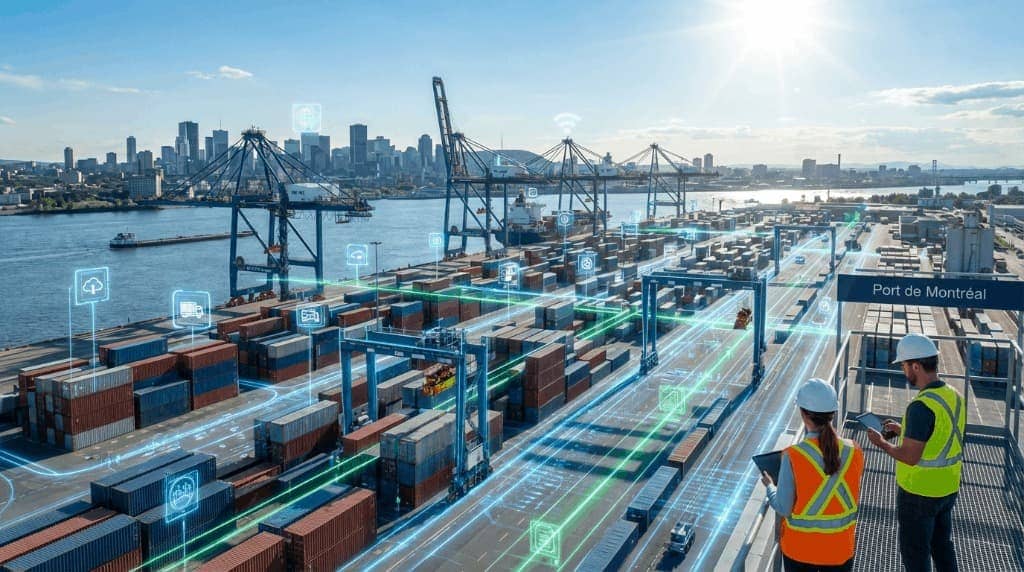
Based in Montreal, Quebec, Scale AI Canada is an investment and innovation hub. It operates as one of Canada’s five Global Innovation Clusters, fueled by hundreds of millions of dollars from both the federal government and private industry. Their mission couldn’t be more different from their Silicon Valley namesake. While scale.com is busy building the data engine for foundational models, Scale AI Canada is hyper-focused on the applied use of artificial intelligence—specifically in supply chains and logistics.
They aren’t labeling data for ChatGPT. Instead, they manage the Scale AI subvention—distributing massive grants to consortiums of companies, universities, and research institutes. Their goal is to fund AI solutions that make global supply chains more efficient, resilient, and sustainable.
The Subvention Engine: How It Works
The whole point of the subvention model is to de-risk AI adoption for traditional, slower-moving industries. Picture a consortium: a major Canadian grocery retailer, an AI startup that specializes in demand forecasting, and a research team from McGill University. They team up and propose a project to use machine learning to predict inventory needs and slash food waste. Scale AI Canada evaluates the pitch. If it gets the green light, they co-invest, covering a huge chunk of the project’s costs. It’s a brilliant way to accelerate innovation in sectors that are usually hesitant to take big technological leaps.
Key Focus Areas of Scale AI Canada
- Supply Chain Optimization: Deploying AI to predict demand, optimize shipping routes, and manage inventory across incredibly complex global networks.
- Healthcare Logistics: Smoothing out the flow of medical supplies, improving patient scheduling, and managing hospital resources using predictive models.
- Sustainable Operations: Shrinking carbon footprints by optimizing transportation routes and minimizing waste through smarter forecasting.
- Workforce Development: Bankrolling training programs to upskill the Canadian workforce in data science and AI integration.
The Impact of the Supercluster
Since it launched, Scale AI Canada has funded hundreds of projects, pumping hundreds of millions of dollars directly into the Canadian AI ecosystem. It has played a massive role in cementing Canada’s reputation as a global leader in applied AI. If Alexandr Wang’s company is building the brains of artificial intelligence, the Canadian supercluster is building the nervous system that connects those brains to the physical world of goods and services.
FAQ: Scale AI Canada
Is Scale AI Canada the same company as Scale AI in Silicon Valley?
No. Scale AI Canada (scaleai.ca) is a government-backed Global Innovation Cluster focused on applying AI to supply chains. Scale AI (scale.com) is a private Silicon Valley company focused on data labeling and generative AI infrastructure.
What does Scale AI Canada do?
Scale AI Canada provides funding (subventions) and support to collaborative projects that integrate artificial intelligence into supply chains, logistics, and operations across various industries.
How do companies get funding from Scale AI Canada?
Companies must form a consortium (usually involving an industry partner, an AI provider, and sometimes a research institution) and submit a project proposal that demonstrates significant potential for AI-driven supply chain improvement.
The Future Horizon: Plans, News, and Insider Forecasts
The AI landscape shifts on a weekly basis. So, what exactly does the future hold for a $13.8 billion data engine?
The Shift from Labeling to Generation
The era of simply paying people to draw bounding boxes around stop signs is coming to an end. The future of Scale AI’s technology lies in complex, domain-specific data generation. As models like GPT-4 and Claude 3 reach human-level performance on general tasks, they are starving for increasingly specialized data to keep improving. They don’t need another million pictures of cats; they need PhD-level physics problems solved step-by-step, or complex, multi-page legal contracts analyzed for hidden loopholes.
To feed this new beast, Scale AI is aggressively recruiting subject matter experts—doctors, corporate lawyers, senior software engineers—to generate this high-fidelity data from scratch. The recent launch of products like SWE-Atlas and Scale AI Prodigy are massive neon signs pointing to this shift. They are evolving from a mechanical turk model into an elite, expert-driven data foundry.
The Defense Imperative
Expect the relationship between Scale AI and the DoD to deepen significantly in the coming years. As global tensions continue to rise, the Pentagon is stepping on the gas, accelerating its adoption of AI for intelligence gathering, surveillance, and autonomous systems. Scale AI’s Donovan platform is perfectly positioned to become the central operating system for these military AI deployments.
Alexandr Wang hasn’t been shy about this. He has made it abundantly clear that Scale AI views its work with the US government not just as a lucrative revenue stream, but as a patriotic duty. This aggressive, unapologetic stance on national security will likely secure them billions in future defense contracts, permanently cementing their position as a critical component of the modern US military-industrial complex.
The IPO Question
Will Scale AI finally go public? That massive $1 billion Series F round gives them an incredible amount of runway. They absolutely do not need to IPO for capital right now. However, the ticking clock of liquidity pressure from early investors and tenured employees will eventually force their hand. Insider forecasts and Wall Street whispers suggest a potential IPO window opening in late 2025 or 2026, assuming the broader tech market remains hungry for AI valuations. When it finally happens, it will be a watershed moment for the industry—offering public market investors their very first pure-play opportunity to buy into the data infrastructure that is actually powering the generative AI boom.

Glossary of AI Terms
- RLHF: Reinforcement Learning from Human Feedback. This is the secret sauce behind ChatGPT. It’s the process of using human annotators to rank, correct, and refine AI outputs, teaching the model how to be safer, more accurate, and less prone to hallucination.
- LLM: Large Language Model. These are the foundational AI models (like GPT-4 or Gemini) trained on vast oceans of text data, giving them the uncanny ability to understand and generate human-like text.
- OCR: Optical Character Recognition. The foundational technology used to “read” and convert different types of documents—like scanned paper invoices or messy PDFs—into clean, editable, and searchable digital data.
- LIDAR: Light Detection and Ranging. A remote sensing method that uses pulsed lasers to measure ranges and map environments in 3D. It is the crucial “eyes” for most autonomous vehicle navigation systems.
Conclusion: The Invisible Empire
You don’t see Scale AI when you ask ChatGPT to compose a poem. You don’t see them when a Waymo self-driving car glides effortlessly through a chaotic intersection in San Francisco. And you don’t see them when a military drone locks onto its target halfway across the world.
But they are always there. They are the invisible labor force, the architects of ground truth, and the massive data engine that is quietly propelling the most significant technology shift of our lives. Whether it is Alexandr Wang’s Silicon Valley unicorn building the brains of artificial intelligence, or the Canadian supercluster building the nervous system of global logistics, the name “Scale AI” is now inextricably linked with the future.
They’re not building the shiny consumer apps that get all the press. They’re building the infrastructure those apps run on. And as history has taught us in every gold rush, the company that sells the pickaxes and shovels tends to be the one that profits.
Share this Article
Enjoyed the deep dive into Scale AI? Share it with your network.